Launches · September 30, 2026 · 10 min read
Google DeepMind’s Gemini 4 Argon raises the output ceiling to one million tokens, posts state-of-the-art scores on DeepSWE and the Vals Index in its own charts, and reaches only Fairwind cyber testers first while API customers and Google AI Ultra subscribers wait behind guardrail work.
On September 30, 2026, Google published a blog post by Koray Kavukcuoglu, chief AI architect and Google DeepMind senior vice president, announcing Gemini 4 Argon as a new frontier model. Google DeepMind’s account on X posted the same news at 8:03 p.m. UTC, describing Argon as built for complex workflows in coding, enterprise knowledge work, and cybersecurity defense, with rollout starting that day for trusted testers in the Fairwind Program. A follow-up post on the same thread highlighted a one-million-token output limit and linked to the full announcement. The model is not a general consumer drop. Google says it is gathering feedback from cyber defenders and other early testers, working through U.S. government voluntary pre-release access, and planning wider availability for developers, enterprises, and consumers, starting with paid API customers and Google AI Ultra subscribers, as soon as guardrails allow.
One million tokens out, sixty-four thousand before
The output limit is the clearest numeric change Google emphasizes for long-horizon work. Gemini 4 Argon’s maximum output rises to one million tokens, up from sixty-four thousand on the previous cap, according to the blog post and the DeepMind thread. Google calls that an industry-leading output budget and argues that when a model can spend hundreds of thousands of tokens in one trajectory, it can reason through multi-step problems without chopping work across sessions. That claim is architectural, not a single benchmark score. It matters most for agents that draft large migrations, long reports, or extended code changes in one run.
Google’s announcement pairs the token headline with internal examples rather than a public leaderboard for output length alone. Researchers used Argon on quantum subroutine optimization and reported beating a published baseline by forty percent in minutes. Argon agents analyzed fleet profiling telemetry and applied memory optimizations Google estimates will free three hundred tebibytes once rolled out, with five hundred tebibytes to one pebibyte in total savings. Those stories are Google-internal narratives. They illustrate why Google wants a larger generation budget, but they are not independently verified in the post.
Benchmarks where Google says Argon leads
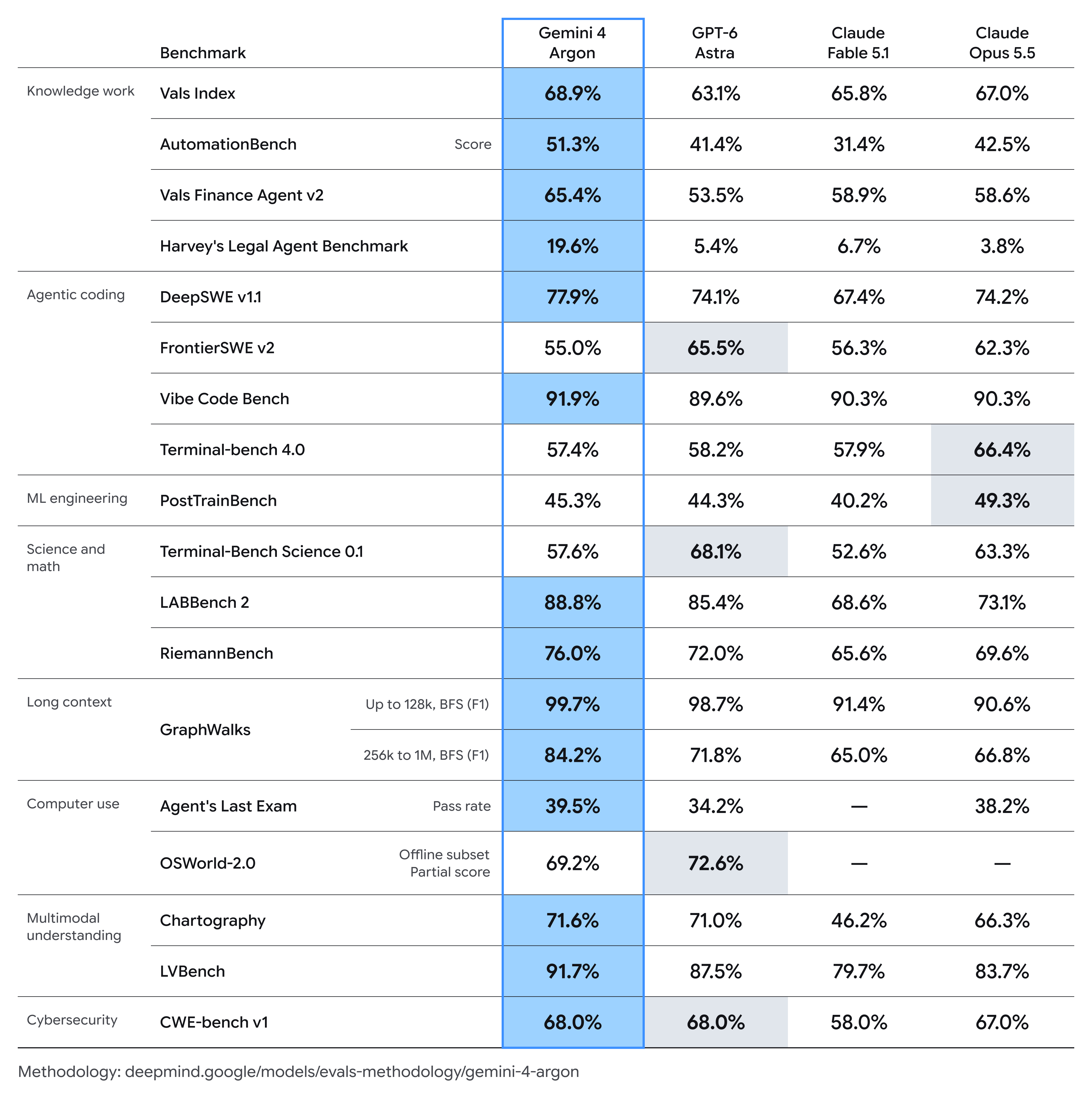
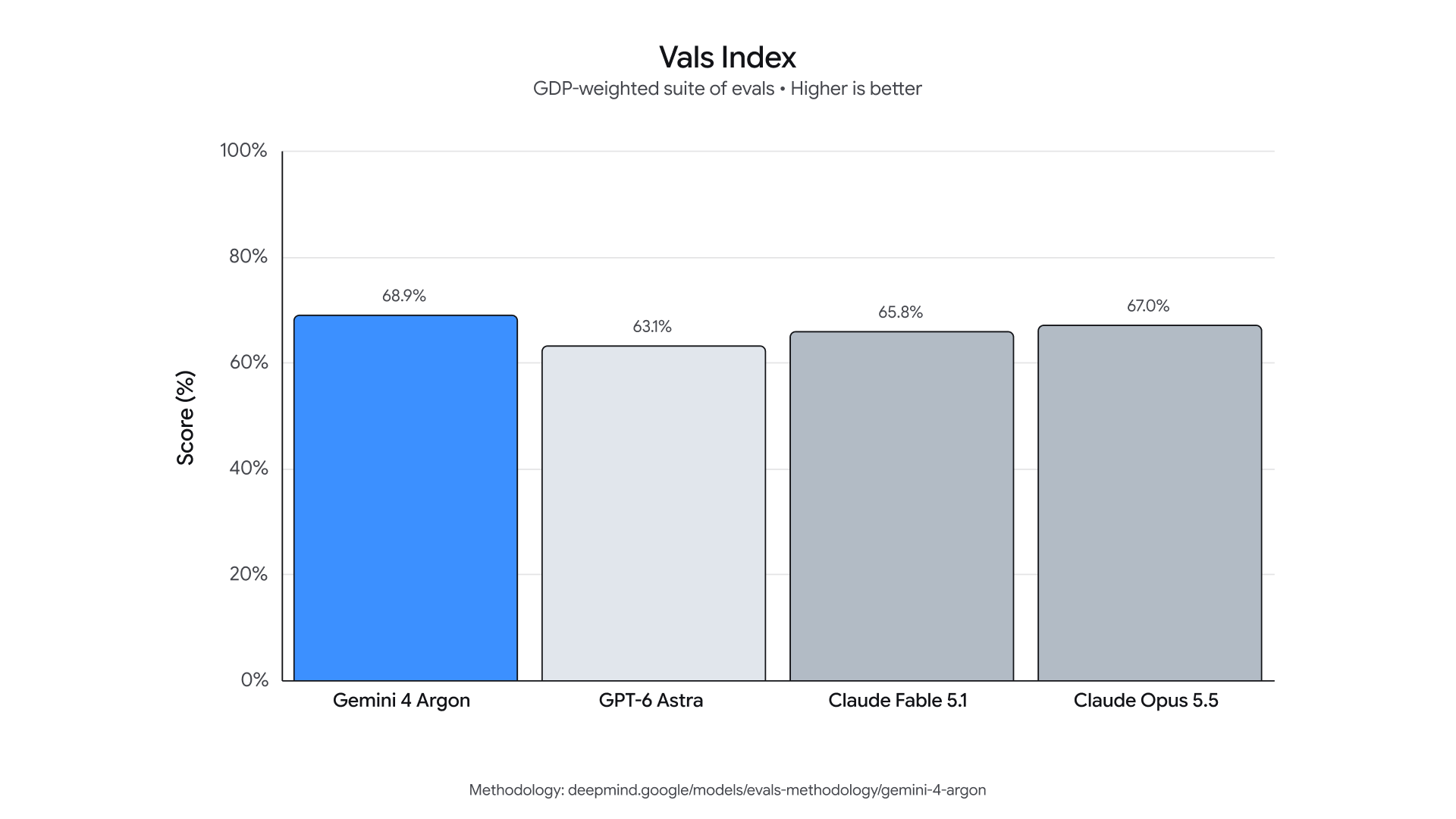
Google’s case that Argon beats rival frontier models rests on a stack of named evaluations, several with published scores and several with animated comparison charts on the blog. On DeepSWE v1.1, which measures long-horizon software engineering in realistic settings, Google reports a state-of-the-art score of 77.9 percent. On the Vals Index, which weights finance, coding, legal, and tax tasks by contribution to U.S. GDP, Google says Argon is the leading model. The post also cites strong results on Vals Finance Agent v2, Harvey’s Legal Agent Benchmark, and Zapier’s AutomationBench, where Argon ranks first with 51.3 percent on end-to-end business workflows. For long video understanding, Google lists LVBench at 91.7 percent and calls that state of the art.
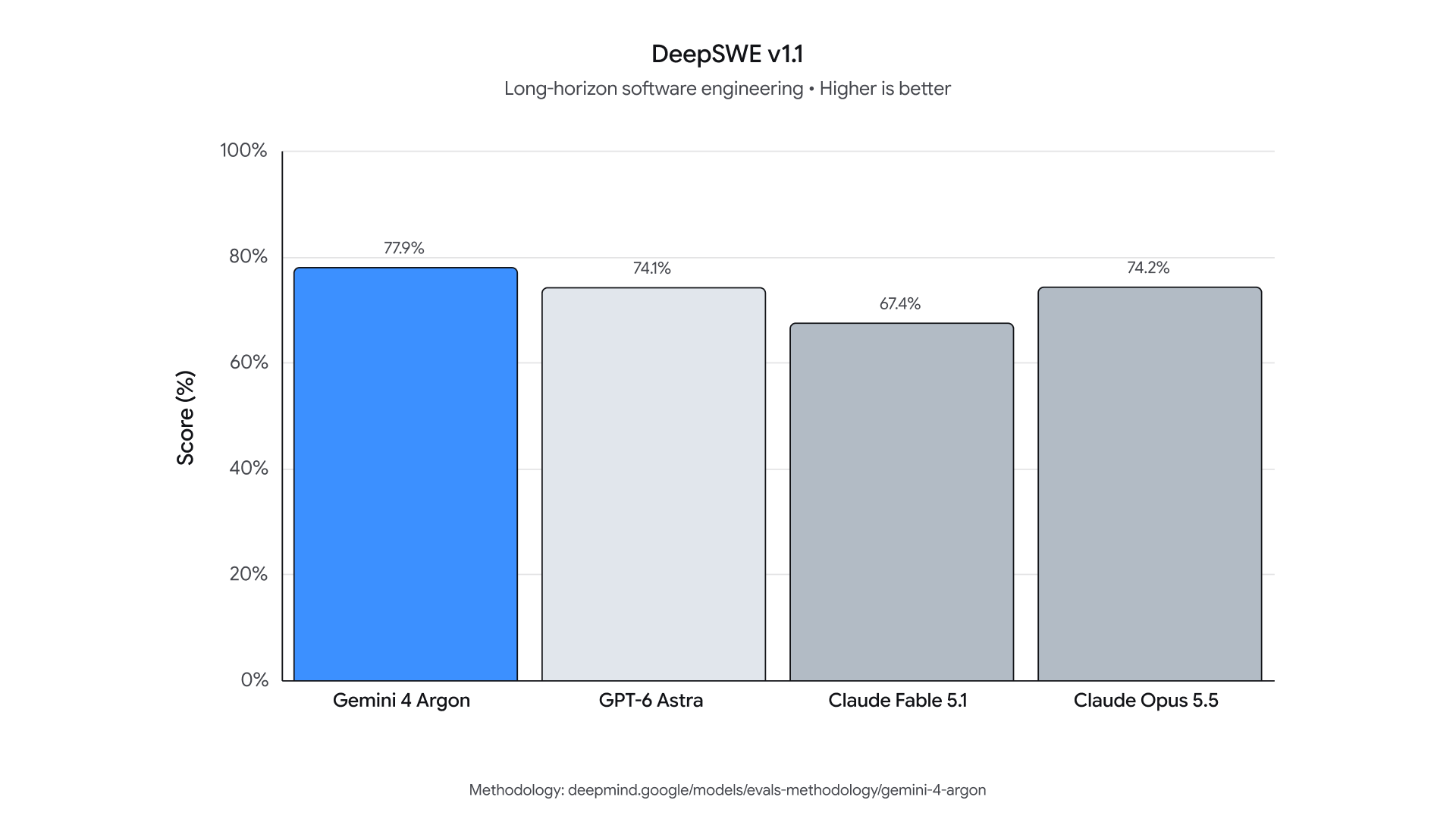
The DeepSWE and Vals charts in Google’s post plot Argon against other frontier systems, including OpenAI’s GPT-6 Astra and Anthropic’s Fable and Opus lines in the Vals visualization. Google does not publish a single composite “beats everyone” number. It publishes separate tasks and lets the charts carry the comparison. TechCrunch’s same-day coverage summarizes Google’s position as scoring significantly higher than those rivals across several benchmarks and notes Vals as an increasingly cited third-party index. Afterimage is not rerunning the benchmarks. The record for what Google claims is the blog post and the charts Google hosted there on September 30.
Cyber defense, CWE-bench, and guardrails off for defenders
Google foregrounds defensive cybersecurity as Argon’s first public mission. The model is trained to find, validate, and patch critical vulnerabilities, according to the announcement. Fairwind Program partners get access first. Wiz is named as an early user through Scan for Good, a program that hunts high-risk exposures in public infrastructure. Google says Argon found a critical healthcare software vulnerability that exposed sensitive personal information worldwide, a severity prior frontier models missed in that demonstration.
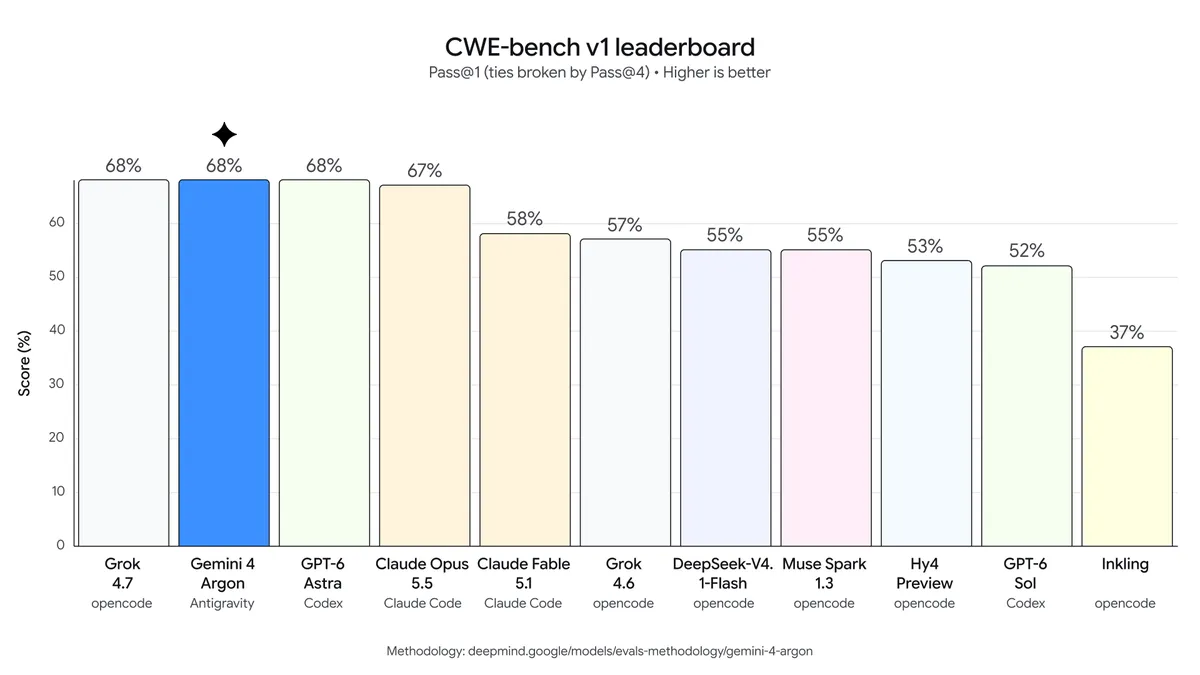
On CWE-bench v1, which tests vulnerability remediation, Google reports a top score of 68 percent, tying for first place and building on Gemini 3.8 Flash Cyber’s performance on the earlier benchmark version. Google also claims gains on internal vulnerability suites across twenty languages and on Wiz’s black-box penetration testing benchmark versus 3.8 Flash Cyber. For trusted defenders and Google’s own security teams, the post says Argon will ship without cyber guardrails so defenders can use full frontier-level capability. That is a deliberate split: stricter misuse controls for general release, reduced cyber restrictions for a vetted cohort.
Safeguards, pricing, and who pays later
Before broad rollout, Google lists four safeguard areas: misuse refusal for cyber and CBRN harm, prompt-injection robustness including Gray Swan’s indirect prompt injection benchmark, misalignment monitoring over chain-of-thought and actions, and hardened sandboxes for high-risk training and evaluation. The post argues for preserving reasoning transparency industry-wide while capabilities rise. Those paragraphs sit next to benchmark brags, not instead of them.
API pricing is specified with an introductory window. Argon will launch at two dollars per million input tokens and ten dollars per million output tokens, with cached input priced at ninety-five percent off the input rate, according to footnote one on the blog. After the introductory period, four dollars per million input tokens and twenty dollars per million output tokens apply. A one-million-token output cap makes the output price line material for long jobs even at intro rates. Google has not published the introductory period’s end date in the materials reviewed here.
Announcement without immediate general access
Google’s September 30 package is a frontier claim set: larger outputs, chart-leading scores on coding and professional tasks, cyber-first access, and a phased safety story. What it is not, yet, is a button in the Gemini app for every user. DeepMind’s social posts promise broader developer, enterprise, and consumer access after tester feedback. Until that gate opens, the public record is Google’s benchmarks, Google’s internal migration anecdotes, and third-party summaries such as TechCrunch calling Argon Google’s most powerful model yet while noting the same Fairwind-limited rollout.
For readers tracking the frontier race, Argon lands in the same week as other always-on agent and model launches from competitors. Google’s differentiation in its own words is the combination of million-token outputs, Vals and DeepSWE chart leadership, and a cyber-defender-first path with guardrails selectively removed for trusted users. Verification still waits on independent runs of the same benchmarks and on what happens when paid API and Ultra subscribers get keys without Fairwind’s narrow cohort.
Sources
- Koray Kavukcuoglu, Google, “Gemini 4 Argon: our next era of frontier intelligence,” September 30, 2026
- Google DeepMind on X, introducing Gemini 4 Argon and Fairwind rollout, September 30, 2026
- Google DeepMind on X, one-million-token output limit and broader rollout plans, September 30, 2026
- Lucas Ropek, TechCrunch, “Google releases Gemini 4 Argon, called its most powerful model yet,” September 30, 2026
- Vals Index benchmark page (linked from Google’s announcement)