Defense · September 29, 2026 · 18 min read
Anduril’s EagleEye page lists Blue Force tracking, a sensor bar, and a helmet family powered by Lattice. The see-through-walls line is a podcast description of a drone overlay, and a production award, if it comes, is a fiscal 2028 possibility.
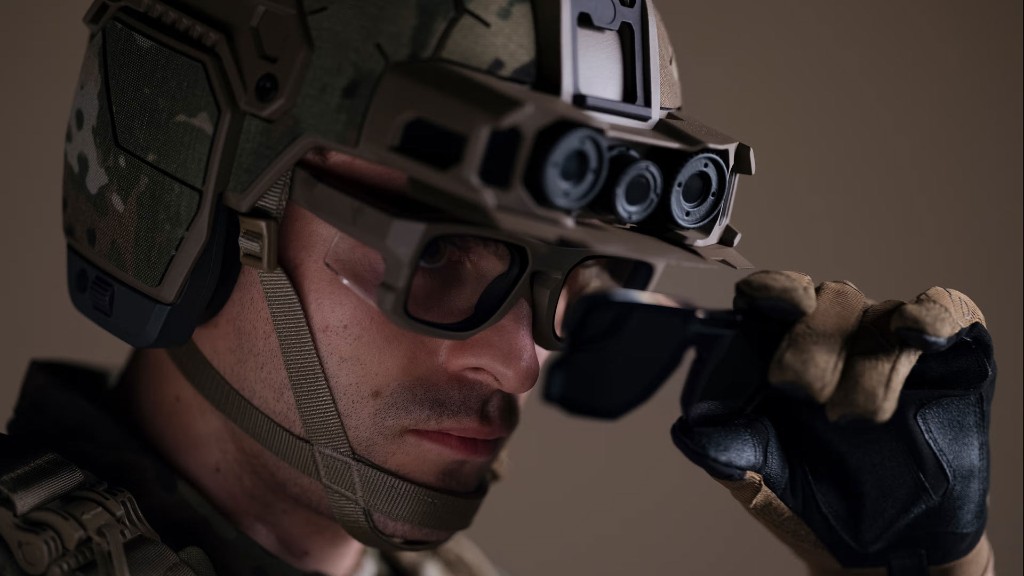
Anduril’s EagleEye page opens in capital letters: “Superpowers for superheroes.” Under that line the company calls the product a family of warfighter augments powered by Lattice, the software it already sells as a command network. The picture is a helmet, clear glasses, and a tan bar of lenses stowed above the eye. A clip posted on April 29 by the account @sourceryy puts a harder sentence on the same name. Kyle Harrison of Contrary, talking with Molly O’Shea on Sourcery, says you can literally see through walls.
Those sentences are on different clocks. The page is a product description, live as of this week, with four labeled blocks: enhanced perception, heightened survivability, lethal connectivity, and mission planning. Harrison is explaining why Palmer Luckey waited years to build the headset he wanted, then describing a drone overhead drawing a person who is still behind a wall. The Army’s paperwork is a third clock. Microsoft’s production agreement, ceiling $21.88 billion, moved to Anduril on April 10, 2025. The hardware competition that replaced the old goggles is still in prototypes. In August, Anduril’s general manager of warfighter systems said a production award could come in fiscal 2028, and that the redesigned night kit, the one the company now wants the Army to take, is scheduled for testing in late January or early February.
What the page lists
The perception block says the wearer sees before being seen, through AI-enhanced digital vision, Blue Force tracking, and six-degree-of-freedom spatial awareness laid onto the real world. The survivability block lists radio-frequency signature detection, rearview cameras, non-emissive lasers, biometric and environmental sensors, and battlefield alerts. Lethal connectivity is the block that names the fight: operators task unmanned vehicles, call for fires, and control robotic teammates while their eyes stay up. Mission planning is a high-resolution collaborative 3D sand table that can host a remote session and a rehearsal.
None of those blocks carries a test score, a weight, a field of view, a battery life, or a price. The page says EagleEye is built to balance weight, ballistic protection, compute, and sensors, and that it can be reconfigured with modular form factors, add-on sensors, and a library of software plug-ins. It names four commercial partners: Meta, Oakley Standard Issue, Qualcomm, and Gentex. The sentence under the names is that those companies have spent billions on augmented reality, combat eyewear, small compute, environmental sensing, and ballistic protection, and that using their work lowers cost and shortens development. The page does not say which partner supplies which part, or what “lowers cost” means against the old program’s unit price.
The October 13, 2025 unveiling, published as an Anduril news post and covered the same day by The Verge, Breaking Defense, and DefenseScoop, used a tighter hardware list than the slogan. Anduril called EagleEye an independently developed, modular family that puts command and control, digital vision, and survivability in one architecture, on top of work the company was already doing for the Army’s Soldier Borne Mission Command program and its software sibling, Soldier Borne Mission Command-Architecture. The Verge quoted Palmer Luckey from that announcement: “We don’t want to give service members a new tool. We’re giving them a new teammate.” The next sentence in the same quote is the one the page’s capital letters are reaching for. “The idea of an AI partner embedded in your display has been imagined for decades. EagleEye is the first time it’s real.”
Glasses, a bar, and a face shield
Luckey told reporters the week of the Association of the United States Army conference that EagleEye was less one product than a platform other people could build on. He said the company was working on four variants. Two were going on the show floor. One was an Oakley Standard Issue glasses design he put at 80 grams, about 2.8 ounces. The other was a ballistic full-face shield designed in house. Logistics troops might wear the light glasses. Soldiers on the line might wear the shield.
He described the shield in numbers the product page still does not print. It fully encapsulates the head, mainly against blast. The display is over 200 degrees wide and over 100 degrees tall. It is not optically transparent. It is a full reprojection system, closer to a night-vision pass-through than to a clear visor with graphics floating in it. Initial Army prototypes, he said, would use the existing Integrated Head Protection System helmet, which he called a poor fit, because that helmet is built to slip rotationally in a hit, and a mixed-reality display has to stay put. Anduril was designing a new helmet. A new plate would carry the computer, the battery, and the radio on the chest, lighter and lower than those three pieces worn separately, and worse at each job than a dedicated battery or a dedicated plate.
DefenseScoop’s account of the same roundtable adds the split he wanted between users. An Osprey pilot and a tank driver should not wear the same system. A person in a warehouse, or an aircraft maintainer, might wear only the glasses, for remote maintenance and a stream back to someone else. The variants would share compute chips and vision sensors and differ on thermal range and on how much armor they carried. He also said some prototypes could integrate with Army rifles, and he reached for Robert Heinlein’s mobile infantry, a ballistic computer that predicts where a round will go given motion, wind, and the Coriolis effect. “So, we’re doing all that,” he told the reporters. That sentence is his. The product page’s lethal-connectivity block names calls for fire and unmanned vehicles. It does not mention a rifle, wind, or Coriolis.
The photograph Anduril uses for the glasses-and-bar arrangement matches the kit Quay Barnett described eleven months later. The full-face shield is a separate variant. Barnett, general manager of warfighter systems, told reporters on August 17, 2026, that the phase-one wearable was glasses, a sensor bar, an edge computer, a battery, and a controller. The glasses came from partnerships with Meta and Oakley Standard Issue. Anduril built the bar: night vision, low-light thermal, and the imaging used when visibility drops. The bar comes down over the glasses at night and stays stowed in daylight. He said that arrangement was a sound way to prove the architecture and the heads-up display, and that he did not believe it was the right nighttime solution.
He was told to leave it alone
The Sourcery clip is Harrison telling that origin story in one pass. In 2017, as Anduril was starting, Microsoft was competing for what became IVAS, augmented reality for warfighters. Luckey had come out of Oculus. Harrison says defense and virtual reality looked, to Luckey, like the same problem, and that he wanted the contract. Early investors told him to wait. The program would consume the company. He let it go. Microsoft got it, did poorly for several years, and then, in Harrison’s phrasing, admitted defeat about a year before the April 2026 conversation. Anduril took over the contract Harrison calls a $22 billion IVAS deal, “which has now become their Eagle Eye product, a ballistic shell helmet with augmented vision.”
Luckey told the same story himself, with the insult left in, at the October 2025 roundtable. He had pitched tactical augmented-reality displays when he was raising money for Anduril. An investor said he could not put the company’s eggs in that basket, because the investor read the pitch as a continuation of his fight with Mark Zuckerberg over who could build the better glasses. “They were somewhat right,” Luckey said. Breaking Defense and DefenseScoop both print that line. He also said he had known the Microsoft architecture would fail. “Not to sound too arrogant, but I knew. I knew that IVAS, as it was architected, was not going to work.” The military, he said, was still going to want a computer, a radio, and a heads-up display on a soldier. Anduril would build the pieces that let it compete when that day came.
The Meta reunion is part of the same arc, and it is easy to overread. Facebook bought Oculus in 2014. Luckey was pushed out in 2017, after a political donation. In May 2025 Anduril and Meta announced a partnership. The Verge, citing TechCrunch from that month, said the collaboration was to develop EagleEye. Luckey’s line at the time, quoted by The Verge from his post, was that he was glad to be working with Meta again, and that his mission had long been “to turn warfighters into technomancers.” In October he was more specific about the hardware. Meta, he told DefenseScoop, was providing some of the waveguide and display technology it had spent billions developing. By the August 2026 briefing, Barnett was still naming Meta and Oakley as the glasses partners. The product page’s partner line matches those two, plus Qualcomm and Gentex. OSI, the name on the October 2025 news post, is Oakley Standard Issue.
A ceiling of $21.88 billion
The number Harrison used, and the number Luckey still treats as the size of the prize, is a ceiling. The Army did not write a check for $21.88 billion. On March 26, 2021, the Army awarded Microsoft a fixed-price production agreement for IVAS, contract W91CRB-21-9-P002. Breaking Defense reported it on March 31. The agreement had a five-year ordering period and five one-year options for support, ten years in all, and a potential ceiling of $21.88 billion. The figure was in a Microsoft email to the reporter, Sydney J. Freedberg Jr., not in the Army’s announcement. Microsoft’s own blog that day, by Alex Kipman, said the Army was moving the HoloLens-based headset from rapid prototyping to production and rapid fielding. The blog does not print $21.88 billion.
The 2018 date that shows up beside the same number marks the start of the work. The production ceiling comes later. Congressional Research Service’s brief on IVAS says that in November 2018 the Army awarded Microsoft an other-transaction agreement “worth up to $22 billion over 10 years.” DefenseScoop’s October 2025 preview uses the same pairing: late 2018, an other-transaction agreement, up to $22 billion over 10 years. The production story from March 2021 is the document that actually carries $21.88 billion, and it says the dollar figure was not in the public announcement. A reader who meets “$22 billion IVAS contract” in a podcast clip is meeting that ceiling after it has been rounded and moved earlier in the timeline.
What transferred in 2025 was oversight of the existing deal, on Anduril’s account of it. Tom Keane, then senior vice president of engineering, told Breaking Defense that on April 10, 2025, the Army signed the contract novation that slid Microsoft’s terms to Anduril. Keane said Anduril was not expecting to produce hardware under that deal. The job was to keep the devices already in the program working. Microsoft, he said, had fulfilled the existing hardware orders. The path to that novation is short. In September 2024 Microsoft and Anduril announced that Lattice would go into the headset. In February 2025 Microsoft said it planned to move the production contract. Luckey, ahead of the formal step, said the transfer would include employees, hardware, intellectual property, and facilities. CRS dates the Army’s approval of the novation to the same April 10.
Asked in October 2025 whether the old ceiling still made sense, Luckey said it did, if the Army wanted the system on every person who would end up in combat holding a rifle. DefenseScoop reported that the service had initially expected to pay $50,000 to $80,000 per unit under IVAS. Luckey said Anduril expected to come in at half of that, and that consumer commoditization would eventually push a unit into the low thousands. He also said he believed augmented reality would reach every soldier’s head before it reached every consumer’s head. None of those figures is a price in an Army award. The $159 million prototyping contract Anduril announced in September 2025 is the hardware number the company has actually published for EagleEye’s Army path.
Ten thousand headsets stay in storage
The record of the goggles Anduril inherited is harsher than the novation press. On July 8, 2026, Army Times, citing the Government Accountability Office’s annual weapons assessment, reported that three versions of IVAS built between 2018 and 2025 were judged not ready for fielding. Nearly $2 billion had been spent. “An Army evaluation reported that soldiers found the headsets difficult to wear and noted that they did not perform better than existing equipment,” the GAO wrote, in the passage Army Times quotes. “As a result, the nearly 10,000 units that were produced are obsolete and will remain in storage.”
Those 10,000 are versions 1.0 and 1.1. CRS says the Army procured 5,000 of each, the first in 2022 with navigation and a weapon-sight link, the second in 2023 with an improved low-light sensor. Early versions, CRS reports, caused “mission-affecting physical impairments,” including headaches, eyestrain, and nausea. A 2022 Department of Defense Inspector General audit, as CRS summarizes it, found the Army had not defined suitable user-acceptance measurements, and warned that the service could waste up to $21.88 billion fielding a system soldiers might not want to use. Army Times, again from the GAO, says problems users reported on 1.0 and 1.1 were not adequately fixed in 1.2: poor low-light performance, and added weight on the helmet. The program went to production with limited evidence from operational testing. After the negative feedback on 1.0, it did not operationally test 1.1 at all. Users, the assessment says, found the result less useful than the legacy equipment it was supposed to replace.
Version 1.2 is the bridge, and it is a thin one. Army Times says about 400 of those goggles will inform Soldier Borne Mission Command, under the contract Anduril now holds. The story says Anduril received funding from IVAS in April after the Army reprogrammed money. It does not say which April. It separately notes that Anduril announced the $159 million prototyping award in September 2025. The GAO’s recommended path forward, as Army Times relays it, is continuous operational assessment, with feedback from brigades, used to shape the first phase of the new program. That is an instruction about method. It is not a finding that EagleEye has passed it.
Two published checks, and a third name
Soldier Borne Mission Command is the hardware redo. Soldier Borne Mission Command-Architecture is the software layer, and Luckey has been careful to say Anduril is alone on that one. “We’re the only people on the architecture contract,” he told DefenseScoop in October 2025. “Lattice is kind of the backbone of this.” The September 2025 award announcement describes SBMC-A as an open software platform on Lattice, with Anduril in the lead and a list of partners beside it: Palantir, L3Harris, Persistent Systems, Sierra Nevada Company, DTC, Maxar Intelligence, and Kägwerks. The hardware competition is a separate set of awards.
On the hardware side, Breaking Defense reported two awards from September 2025. Anduril said it had a $159 million contract for initial prototyping and planned to deliver close to 100 units in the April-to-June 2026 window. Rivet’s chief executive, David Marra, said his company had signed a $195 million contract covering an 18-month prototyping sprint, engineering, testing, and 470 “production representative” devices. Rivet’s design, from the photos on its site at the time, looked like glasses. DefenseScoop’s August 2026 update adds a third name the earlier stories did not treat as a peer: Elbit Systems of America was also tapped to provide a solution. That story does not print Elbit’s dollar figure or its unit count.
Luckey, the week of the unveiling, told DefenseScoop the same near-term delivery he had given the contract story: roughly 100 EagleEye units to selected Army personnel in the second quarter of 2026, with many of the components already in production. He said some Army officials had already tried working prototypes, including in training scenarios that involved commanding drones and launching loitering munitions. The Army did not answer DefenseScoop’s request for comment that Friday. He also said Anduril would sell the system beyond the U.S. military, named firefighters and other first responders as near-term possibilities, and said the company was in conversations with elements of the Department of Homeland Security, including the Coast Guard and Border Patrol. “We’re prioritizing the Army first, because we just have to nail this and get this right.” No other customer is named as having signed.
What the old headset already did
The closest thing to a measured demonstration in Anduril’s own contract announcement is not EagleEye. It is Lattice running on IVAS 1.2 headsets used as surrogates. The company said it had drawn on more than 260,000 hours of soldier input from the IVAS program, integrated those headsets with Lattice, and completed multiple field tests. SBMC-A had been through four soldier exercises, in combat-training scenarios, on a mesh of heads-up displays and body- and vehicle-borne computers. Through that setup, drones were tasked from more than three kilometers away, over a line-of-sight radio, from a Lattice-connected IVAS 1.2 headset, so a soldier could send the drone without a dedicated pilot.
That is a real claim, and it has a boundary. The headset in the test is the Microsoft-era 1.2, the same family the GAO says failed to fix low-light performance and helmet weight, of which about 400 units are supposed to inform the new design. The radio link is line of sight, past three kilometers. The announcement does not say the soldier saw a person through masonry. It says the soldier tasked a drone from the heads-up display. Army Times, quoting Anduril’s September language back in July 2026, also repeats the company’s line that the $159 million award was the largest effort of its kind “to equip every soldier with superhuman perception.” The GAO assessment sitting in the same news cycle said the previous attempt at that perception left 10,000 headsets in a warehouse.
Phase one stayed on Anduril’s books
By August 17, 2026, the delivery story had a correction in it. Barnett said Anduril was moving from phase one to phase two, that phase-one systems had already been delivered, and that two weeks earlier the 75th Ranger Regiment had used them at Anduril’s Seattle test site, in field-like conditions, so the company could fold the feedback into phase two. A company spokesperson then told DefenseScoop, the same night, that those phase-one systems remained Anduril-owned and were not formal contractual deliveries. The preferred phase-two configuration would be the formal deliverable.
Read against the October promise, that clarification matters. Luckey had said roughly 100 units would go to Army personnel in the second quarter of 2026. Barnett in August put the phase-one count in the “low hundreds,” and the company said those hundreds were not the contract delivery. The formal batch is the redesign: a digital interface the government has approved Anduril to pursue, with weight and form-factor savings from putting the display closer to the eye, 4K displays, and a field of view Barnett put at about 70 percent wider than current night-vision systems. Because the night picture is digital, he said, the daytime overlays can ride in it. He also said new cameras would be part of phase two, and that Anduril was spending its own research money on voice activation and on sensors that are not in the program’s specification, including frontier models worn on the body.
The counts for that next batch are in the same story, and they do not all match on the first telling. Barnett said phase two would be “several hundred” systems, with testing in late January or early February. The spokesperson’s email that evening put the phase-two prototype delivery at 170, and said that across prototyping and initial production for testing, hundreds of systems would ultimately be delivered. A downselect and a production award, Barnett said, could come in fiscal 2028. The total value of Soldier Borne Mission Command is not known. DefenseScoop notes that IVAS had been expected to be worth up to $22 billion before it was scrapped. Anduril has built manufacturing capacity for thousands of systems, Barnett said. Capacity is not an order.
The user-interface work is the part of the August briefing that answers the IVAS complaints most directly, and it is still Anduril’s account. Barnett said the old controller’s buttons were poor, and that the new one is a dial and a press. A short hold brings up a quick picture. A long hold on the same control opens a more detailed view. A release clears it. There is a mode that drops the wearer back to the unaided view. He said a path that used to take something like 21 button clicks was down to two. The full heads-up display weighs about 110 grams. That figure and Luckey’s 80-gram glasses are both on the record. They are different objects: the glasses alone, in October 2025, and the full display, in August 2026. The company is waiting on Army approval before it can quote the Rangers who used the phase-one kits. Until those quotes exist in public, the soldier-side record of EagleEye is the company’s.
Cybersickness is the complaint Luckey has been the loudest about, and the one with the least new evidence in the August briefing. At the October roundtable he told reporters, “I have got this shit figured out. Like, I’ve done this before. I’ve done it more or less perfectly.” He defined the mechanism in plain terms. If the eyes and the inner ear disagree, the body treats the mismatch as poison and tries to vomit. He said Anduril had also dealt with latency, reprojection, and calibration, the other routes to the same nausea. He called himself the best person at Anduril to do this work, and said he knew that sounded arrogant. Barnett’s August remarks do not revisit nausea. They talk about weight, the dial, and a night redesign that has not started its scheduled test.
The wall
Harrison’s see-through-walls line comes after the contract history. He is describing a use case. The product page does not list it as a specification. In the clip, a ghost drone is overhead. The drone knows where a person is. Augmented reality draws that person moving, on the other side of a wall. The combination is the point he is making about Anduril: the product was never one airframe, it was software-defined hardware that can share a picture. The tweet that carries the clip leads with the five words. “You can literally see through walls.”
Anduril’s EagleEye page does not say that. It says rearview cameras, Blue Force tracking, radio-frequency detection, and the ability to task unmanned vehicles. The three-kilometer drone tasking in the September 2025 announcement was a line-of-sight radio link from an IVAS 1.2 surrogate, and the announcement describes commanding the drone, not rendering a hidden person. Luckey in October said prototypes had been used to command drones and to launch loitering munitions in training. He did not, in the stories from that week, describe a wall becoming transparent.
A reply under the April 29 post, from Stefan Larsen, says the system is “still just a concept.” That was a fair reading of a podcast clip sitting on top of an October unveiling, if the reader had not been following the prototype contracts. It is a weaker reading in September 2026. Rangers used a phase-one kit in early August, at Anduril’s site. The company then said that kit was still Anduril’s property. The design Anduril wants judged, with 4K digital night vision and a wider field of view, is the batch of 170 prototypes scheduled for late January or early February. A production decision, on the company’s own timeline, could arrive in fiscal 2028. Between a concept and a fielded helmet there is a long middle. EagleEye is in it. The page is already written in the language of a finished superpower.
Sources
- Anduril, EagleEye product page
- Anduril, “EagleEye Puts Mission Command and AI Directly into the Warfighter’s Helmet,” October 13, 2025
- Anduril, “Awarded Contract to Redefine the Future of Mixed Reality,” September 2025
- sourcery, clip of Kyle Harrison on EagleEye, April 29, 2026
- Sydney J. Freedberg Jr., Breaking Defense, on the $21.88 billion production agreement, March 31, 2021
- Alex Kipman, Microsoft, on the move to production, March 31, 2021
- Ashley Roque, Breaking Defense, on the April 10, 2025 novation, April 2025
- Ashley Roque, Breaking Defense, on the AUSA unveiling, October 13, 2025
- Brandi Vincent, DefenseScoop, Palmer Luckey’s preview, October 13, 2025
- Dominic Preston, The Verge, October 13, 2025
- Hope Hodge Seck, Army Times, on the GAO assessment, July 8, 2026
- Jon Harper, DefenseScoop, on the phase-two redesign, August 17, 2026
- Congressional Research Service, “The Army’s Integrated Visual Augmentation System (IVAS) / Soldier Borne Mission Command (SBMC)”